
Please Choose Your Language
Views: 0 Author: Site Editor Publish Time: 2026-06-26 Origin: Site
Keeping children physically active indoors during harsh winter months or stormy weather often feels like an impossible task. Parents frequently watch their kids default to passive screen time out of sheer boredom when stuck inside. Traditional pre-programmed toys lose their appeal rapidly, resulting in the notorious "bored after a week" syndrome where expensive toys gather dust. Children require dynamic physical outlets to burn excess energy safely without risking damage to themselves or living room furniture. Fortunately, modern active-play alternatives offer highly replayable, vigorous experiences right on your floor. This comprehensive guide provides a clear, evidence-based framework for evaluating core features before you make a purchase. You will discover exactly how to choose an interactive toy ensuring longevity, rigorous safety, and sustained engagement for your household.
Audio Customization Extends Lifespan: Bluetooth connectivity prevents song fatigue by allowing parents to sync current favorite tracks.
Visual Feedback is Critical: LED light-up features dictate the accuracy and engagement level of the play session.
Safety Precedes Software: Anti-slip backing and non-toxic, durable materials are mandatory for safe use on hard indoor surfaces.
Progression Drives Retention: Multi-level game modes ensure the mat scales with the child’s developing motor skills.
Digital and interactive features directly dictate sustained physical output. Kids abandon boring toys quickly. If interactive elements fail to capture attention, physical activity drops immediately. We must carefully evaluate how internal software keeps children jumping, stepping, and moving for extended periods.
Older fixed-track toys typically loop three to four generic melodies. Children memorize these patterns rapidly. Once they memorize the music, boredom sets in. The transition to a Bluetooth dancing mixer playmat solves this problem entirely. Parents can sync contemporary pop songs, beloved movie soundtracks, or specialized high-energy kids' playlists. This audio customization guarantees fresh experiences every single day.
When evaluating these devices, audio-visual latency represents a critical pass/fail metric. Look specifically for Bluetooth 5.0 or higher protocols. A delay between the paired device's music and the floor sensors completely breaks the user experience. If a child steps on a beat but hears the sound a half-second later, frustration builds quickly. Low latency ensures perfect synchronization between physical footwork and musical rhythm.
Visual indicators guide complex footwork seamlessly. Children process bright visual cues much faster than audio instructions alone. A high-quality light-up Bluetooth dance mat provides instant, undeniable feedback. When a foot lands correctly, the zone illuminates brightly. This immediate reward loop encourages continuous play.
Success criteria for visual tracking depend heavily on hardware quality. Look for products featuring distinct, multi-color LED zones. These lights must remain clearly visible in bright daytime living rooms. They must also avoid causing harsh glare in low-light environments. Poorly lit indicator zones confuse younger users and disrupt gameplay flow.
Best Practice: Always test LED visibility from a standing adult height. If you struggle to see the illuminated zones clearly, your fast-moving child will definitely miss them.
Motor skill development relies on gradual scaffolding. A flat difficulty curve frustrates beginners and bores advanced users. A Bluetooth level-up dancing mat uses adaptive progression to solve this challenge. Game modes scale upward logically. This ensures the toy grows alongside your child's developing coordination.
Standard progression tiers typically include four to six distinct game modes. Toddlers between ages three and five require slow, single-step prompts. These early stages focus entirely on basic direction recognition. Older kids between ages six and twelve demand rapid, multi-step combinations. Advanced stages often introduce complex memory games or fast-paced freestyle modes.
Progressive Difficulty Mechanics Chart | |||
Progression Tier | Target Age Group | Core Mechanic | Physical Benefit |
|---|---|---|---|
Level 1: Beginner | Ages 3-5 | Single-step visual matching | Basic spatial awareness |
Level 2: Intermediate | Ages 5-7 | Two-step sequential memory | Improved balance coordination |
Level 3: Advanced | Ages 8-10 | Rapid multi-pad combinations | Cardiovascular endurance |
Level 4: Freestyle | Ages 10-12+ | Unrestricted rhythm matching | Creative expression, stamina |
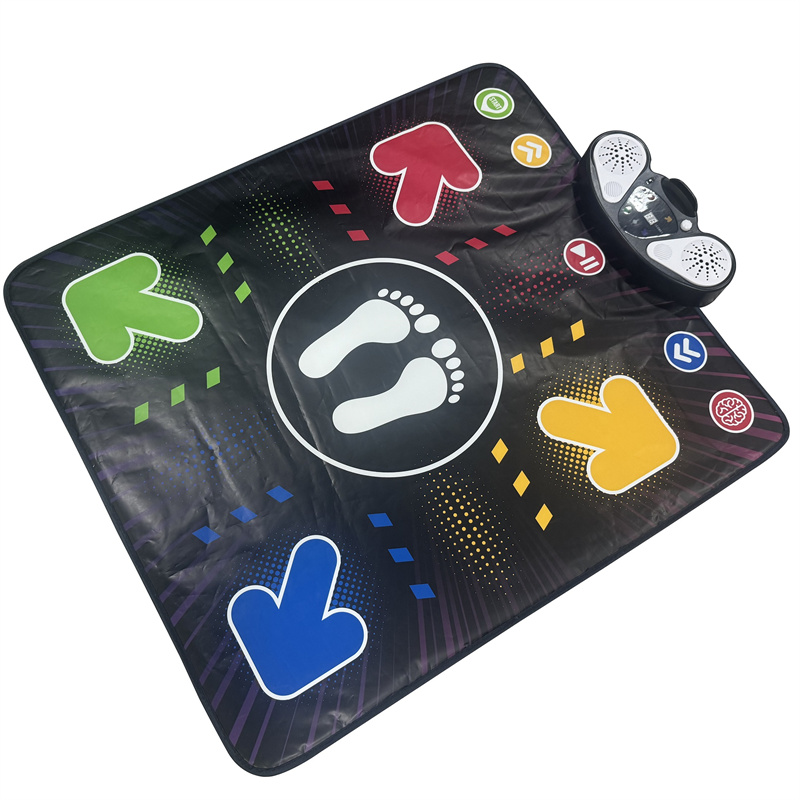
Deploying an active toy in a central living room introduces unique physical realities. Children stomp, jump, and slide repeatedly. Hardware must withstand aggressive daily use. A flimsy product rips easily, creating significant tripping hazards. We must evaluate material strength rigorously.
Top-tier products utilize heavy-duty, waterproof PEVA (Polyethylene vinyl acetate) or similar non-toxic materials. PEVA remains highly durable under constant stress. It also avoids harmful chemicals commonly found in cheaper plastics.
Implementation realities dictate strict cleaning requirements. Kids usually play in bare feet or socks. They frequently bring snacks and drinks near the play area. Accidental spills happen constantly. Wipe-clean surfaces are an absolute non-negotiable feature. You should quickly wipe away sticky juice spills using a damp cloth without short-circuiting internal electronics.
Indoor hardwood floors pose a severe slip hazard. A lightweight product slides unpredictably when a child leaps onto it. This creates a dangerous environment. Anti-slip technology requires careful verification.
Evaluation criteria emphasize the backing material. Verify the presence of thick, textured rubber or high-density EVA foam. These materials grip smooth floors aggressively. Avoid products requiring secondary rug pads or double-sided tape. If you must tape a toy down to make it safe, the design is fundamentally flawed.
Common Mistakes: Do not place active floor toys on top of loose area rugs. The rug itself will slide, nullifying the toy's built-in anti-slip backing.
Load-bearing capacity indicates overall manufacturing quality. Quality interactive floor gear supports at least 150 pounds comfortably. This accommodates aggressive jumping forces. It also allows older siblings or parents to join the fun safely.
Examine the edge stitching closely. Cheaply made alternatives feature single-thread seams. These seams burst after a few intense sessions. Premium options utilize reinforced double-stitching around the entire perimeter. Strong seams keep internal wiring securely protected from external moisture.
Routine maintenance often determines how frequently kids play. If a toy takes twenty minutes to set up, parents leave it hidden in the closet. Space management in an indoor setting requires highly practical solutions.
Traditional setups require multiple AA batteries. Bright LEDs and loud speakers drain standard batteries rapidly. This leads to frustrating replacement cycles. You frequently find yourself unscrewing tiny battery doors late at night.
Built-in USB rechargeable batteries offer a superior alternative. We make a transparent assumption here: rechargeable systems carry a slightly higher upfront cost. However, they eliminate ongoing battery replacement fatigue entirely. You plug the device into a standard wall charger overnight. It remains fully ready for energetic play the next morning.
Analyzing your deployment space prevents cramped, unsafe play environments. Standard setups require a minimum four-by-four foot clear radius. You must move coffee tables, floor lamps, and sharp obstacles out of this radius.
Assess foldability thoroughly. Heavy-duty internal wiring must withstand repeated folding. Cheap wires sever internally when rolled up for closet storage. Look for products explicitly advertising flexible sensor pathways.
Measure a flat, obstacle-free floor area of at least 4x4 feet.
Sweep the floor surface to remove dust, ensuring maximum anti-slip grip.
Unfold the unit completely and press it flat to remove storage creases.
Connect your smart device via wireless protocol and adjust the baseline volume before play begins.
Finalizing a purchase decision requires actionable evaluation steps. You must align product capabilities with your household's specific needs. A perfect toy for a toddler might disappoint a ten-year-old completely.
Evaluate the primary user's developmental stage carefully. Toddlers between three and five need bright, obvious visual feedback. Prioritize simple "Simon-says" mechanics. Avoid overly complex scoring systems. These young users just want cause-and-effect enjoyment.
Older children from ages six to twelve demand competitive features. Seamless wireless syncing becomes crucial here. They want their specific music loudly. Prioritize high-speed combinations, accurate score tracking, and accessible volume controls. They enjoy challenging themselves and breaking previous high scores.
Warranties act as vital trust signals. Interactive floor electronics endure literal stomping daily. Sensor degradation remains the most common failure point across the industry. Manufacturers offering generous guarantees demonstrate confidence in their hardware.
Look for minimum 90-day guarantees or clear return policies. If a brand only offers a 14-day window, they likely anticipate early sensor failure. Reliable customer support ensures you receive prompt replacements if internal wiring faults occur.
Before checking out, take three practical steps. First, measure your intended living room play area accurately. Second, verify your specific floor surface compatibility. Third, check the primary user's tablet or smartphone to ensure current wireless pairing compatibility. These simple checks prevent frustrating return processes later.
Material Safety & Durability Comparison | |||
Surface Material | Waterproof Rating | Tear Resistance | Cleaning Method |
|---|---|---|---|
Standard PVC | Moderate | Low | Spot clean only |
PEVA (Recommended) | High | Excellent | Damp wipe |
Woven Fabric | None | High | Machine wash (rare) |
Selecting the ideal Bluetooth dance mat involves looking past flashy packaging. The best options expertly balance customizable audio streams, scalable difficulty levels, and rigorous anti-slip safety standards. You must prioritize daily durability over superficial gimmicks.
Remember to seek out non-toxic, wipe-clean PEVA materials. Ensure the base layer utilizes heavy-duty rubber to prevent dangerous slipping on hardwood surfaces. Finally, verify the manufacturer provides a robust warranty against sensor degradation. Taking these actionable steps guarantees your family enjoys a highly replayable, active indoor toy for years to come.
A: Most interactive mats connect directly to smartphones or tablets to output audio through the mat's built-in speakers. They typically do not pair directly to smart TV interfaces. However, you can mirror your phone or tablet screen to your TV while the mat handles the audio and sensor inputs.
A: Yes. They generally perform better on low-pile carpets than on bare hardwood due to increased natural friction. However, extremely plush or thick-shag carpets may cause the mat to shift unevenly, occasionally leading to minor sensor registration issues during rapid gameplay.
A: Standard individual models are explicitly designed for one user's foot traffic. Having two kids jump simultaneously causes sensor confusion and inaccurate scoring. If multiple children want to play simultaneously, you should look for dual-player models featuring split-screen or split-mat structural designs.