
Please Choose Your Language
Views: 0 Author: Site Editor Publish Time: 2026-06-21 Origin: Site
Many parents share a common dilemma when introducing a child to music. We want to spark their creativity early, but dread investing in a heavy digital piano. All too often, that expensive instrument becomes a dusty piece of furniture. Finding a low-friction, high-engagement stepping stone matters immensely for toddlers. Expecting young children to sit completely still for formal lessons rarely succeeds. They require a playful, interactive method to explore sound without rigid pressure. This guide helps you evaluate if a piano mat fits your child's age, room space, and developmental stage. We will explore key benefits, sizing realities, and the exact developmental milestones you should watch. Read on to discover how to make a smart, space-saving musical investment for your home.
Piano mats bridge the gap between gross motor play and early auditory development without the pressure of formal lessons.
They serve as a cost-effective, space-saving testing ground to gauge a child's genuine interest in music before upgrading to a standard instrument.
When evaluating options, parental priorities should focus on slip-resistant materials, adjustable volume controls, and realistic polyphony (sound accuracy).
While not a replacement for traditional piano posture or technique, a keyboard playmat successfully teaches foundational concepts like pitch, rhythm, and cause-and-effect.
Parents constantly struggle to balance high musical aspirations with everyday reality. A typical three-year-old possesses an incredibly brief attention span. Expecting them to sit quietly at a massive 88-key instrument feels completely unrealistic. Traditional desktop keyboards demand significant floor space and require a serious level of commitment. Young children rarely have the fine motor skills needed for proper finger placement. Their hands are simply too small for seated, structured play. The physical anatomy of a preschooler makes reaching octaves impossible.
Instead of sitting still, young kids thrive on whole-body, kinesthetic learning. They understand their environment through physical movement. They want to stomp, jump, crawl, and dance across the floor. A traditional piano restricts this natural urge to move. This restriction creates immediate friction between the instrument and the child. When learning feels like a rigid chore, children quickly abandon the activity.
We can eliminate this friction by shifting our entire approach. You can use an interactive floor toy as a low-stress evaluation tool. It allows you to test their musical aptitude safely. You observe their rhythm and interest without feeling guilty about an unused instrument. Psychologically, "instrument guilt" burdens many parents. You buy something beautiful, the child ignores it, and frustration builds. This playful compromise removes that burden entirely. It keeps music joyful, physically engaging, and entirely on the child's terms.
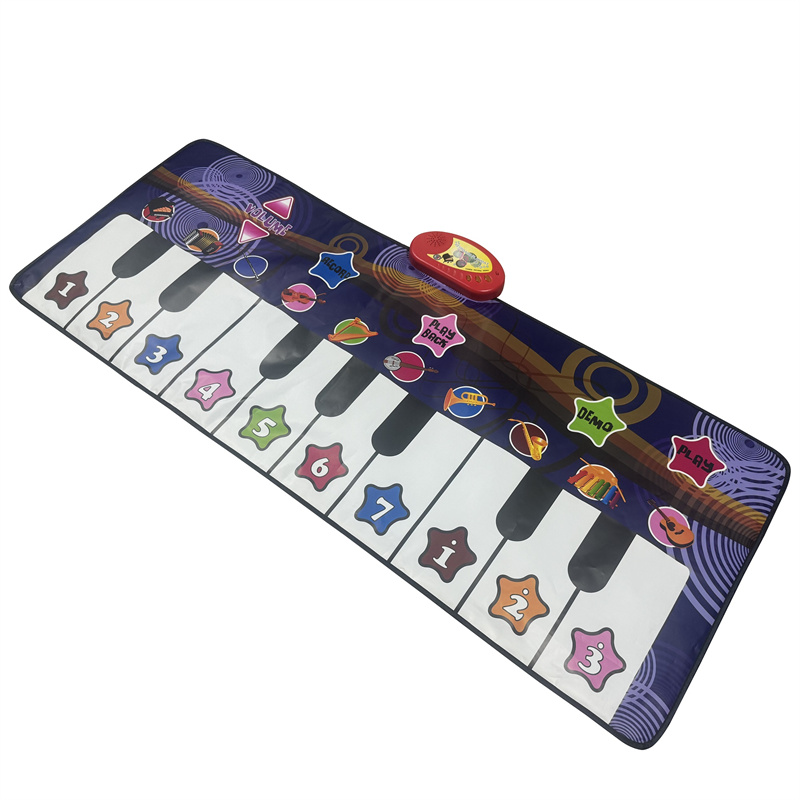
Integrating music with active physical play yields incredible developmental benefits. A keyboard playmat transforms passive listening into an active adventure. Children do not just hear the notes; they feel them beneath their feet. Recognized early childhood education frameworks heavily emphasize play-based learning. They suggest that active participation cements new neural pathways faster than passive observation.
Here are the core developmental advantages for early learners:
Gross Motor Integration: Kids build critical coordination when they step and jump on large keys. Balancing on one foot to reach a high note strengthens core muscles. It improves bilateral coordination as they alternate feet. This physical exertion pairs naturally with musical awareness.
Immediate Gratification and Autonomy: Toddlers love doing things by themselves. They can unroll the toy and start playing instantly. They never need a parent to lift them onto a heavy bench. They do not have to mess with complex adapters or dangerous wall plugs. This independence builds deep creative confidence.
Complex Sensory Processing: This style of play combines auditory, visual, and physical feedback. Bright colors and printed numbers provide visual cues. The physical impact of stomping reinforces the action. Hearing the corresponding note completes a highly effective multi-sensory learning loop.
Play-based learning thrives on autonomy. When you give a child control over their environment, their engagement skyrockets. They explore sequences and sounds at their own pace. They test boundaries without fear of making a mistake. This unstructured exploration forms the absolute bedrock of a lifelong love for music.
Not all floor pianos offer the same quality, safety, or longevity. You must look past the bright colors to evaluate the actual construction. Finding a gigantic keyboard playmat requires balancing durability with practical living room realities. You want a product that withstands daily abuse.
Safety remains your absolute top priority. You must demand non-slip backing before making a purchase. Look for PEVA materials or textured rubber grips. Kids will run, jump, and slide across this surface continuously. A slippery back creates a serious fall hazard on smooth floors. Furthermore, the top layer must use non-toxic materials. Toddlers touch the surface and frequently put their hands in their mouths. It should also feature an easily wipeable surface for inevitable juice spills and sticky fingers.
Loud toys quickly become a parent's worst nightmare in a small house. Manual volume control is a critical feature you cannot ignore. You need the ability to turn the sound down during quiet hours. Pay close attention to the internal speaker quality. The audio should remain clear, even when kids stomp heavily. It should never distort into harsh, piercing static. Poor audio quality discourages children from recognizing accurate pitch.
A larger surface provides bigger targets for clumsy toddler feet. However, you must measure your available floor space first. A massive toy sounds fun until it dominates your entire living room. The product must fold up easily and quickly. Zero-footprint storage keeps your home organized and prevents tripping hazards when playtime ends.
You should expect reliable battery life from modern toys. Look for models featuring an automatic shut-off function. This clever feature prevents battery drain when a distracted child walks away. Inspect the wiring around the main plastic soundbox. Reinforced seams prevent broken electrical connections after weeks of heavy jumping.
To simplify your evaluation process, review this quick comparison chart:
Best Practices | Common Mistakes |
|---|---|
Always verify non-slip backing materials before purchasing. | Placing a smooth-backed toy directly on polished hardwood floors. |
Choose models with manual volume adjustment buttons. | Ignoring speaker quality, resulting in distorted, piercing sounds. |
Ensure the top layer is waterproof or easily wiped clean. | Trying to machine-wash the item, which destroys the internal sensors. |
Look for an automatic battery shut-off feature. | Leaving the device powered on indefinitely, draining batteries quickly. |
We need a completely honest assessment of what these toys can achieve. A rainbow piano dance mat will not turn your child into a classical prodigy overnight. You should always avoid exaggerated marketing claims. It will never teach proper hand posture or seated ergonomics. It cannot teach finger weight, thumb tucking, or intricate sheet music reading. Accepting these limitations sets you up for success.
Despite those physical limitations, it successfully imparts vital musical fundamentals. Children quickly learn the concept of directional pitch. They discover that moving left produces low sounds. Moving right creates higher sounds. This left-to-right cognitive mapping perfectly mirrors a real piano keyboard. They naturally develop steady beat recognition through rhythmic stomping. Eventually, they grasp basic melodic sequencing. They realize that stepping on three specific colors plays a familiar nursery rhyme. They learn cause-and-effect in its purest auditory form.
Think of this interactive floor toy as a foundational musical primer. You are watching for specific developmental milestones. Initially, young children will just stomp randomly to make loud noises. Over time, their play becomes highly intentional. Once a child consistently attempts to play specific melodies, they are evolving mentally. When they try to recreate songs rather than just jumping wildly, they are ready for the next step. This shift in behavior marks the perfect time to introduce a traditional desktop keyboard.
Parents often wonder exactly when to upgrade their musical tools. We can use a simple age and development framework to guide this crucial decision. Buying the right tool at the right time prevents frustration.
Ages 2 to 4: Opt for a floor mat. Your primary focus remains on gross motor skills. Basic sound recognition and cause-and-effect rule this developmental stage. Formal keyboards will only confuse and bore them.
Ages 5 to 6: Welcome to the transition zone. A mat still provides high engagement and fun weekend activity. However, if fine motor skills appear advanced, consider a basic unweighted desktop board. You can use both tools simultaneously to bridge the gap.
Ages 7 and Up: Skip the floor mat entirely. You should invest in a beginner digital piano with standard-sized keys. Delaying this transition might hinder the development of proper finger technique. Older kids possess the attention span required for seated practice.
We can map these choices based on space requirements and financial commitment. Making the right choice protects your wallet and your living room real estate.
Decision Factor | Floor Mat | Desktop Keyboard |
|---|---|---|
Financial Commitment | Extremely low initial investment. Perfect for testing the waters. | Higher investment for hardware, stands, and potential lessons. |
Storage Footprint | Zero-footprint. Folds easily into a small drawer or toy bin. | Requires a dedicated desk space or a bulky floor stand. |
Primary Learning Goal | Evaluate basic interest and build steady rhythm. | Develop proper finger technique and read sheet music. |
Portability | Highly portable for family travel or weekend playdates. | Generally heavy, cumbersome, and stationary. |
A piano mat is ultimately an experiential learning tool cleverly disguised as a colorful toy. It remains the perfect solution for the decision-stage parent. If you feel unsure about your child's long-term musical commitment, this provides the answer. It safely bridges the gap between active gross motor play and early auditory learning. You save valuable floor space while actively nurturing their creativity.
We strongly encourage you to review top-rated, safety-certified options carefully. Use the exact evaluation criteria we discussed today. Focus strictly on models featuring reliable manual volume control, durable wipeable materials, and non-slip backing. Avoid slippery products that put active toddlers at risk. Take the leap, clear some floor space, and watch your living room transform into an interactive musical playground.
A: They can be dangerously slippery if they lack proper backing. You must check the product specifications for non-slip materials like PEVA or textured rubber. If your chosen model lacks grip, we highly recommend placing an underlying rug pad beneath it to prevent dangerous sliding on polished floors.
A: Most entry-level models feature limited polyphony. This means the internal technology only supports one or two simultaneous notes. While kids cannot play complex three-note chords, they can easily trigger two keys at once for basic harmonies. This limitation rarely bothers toddlers focused on single-note melodies.
A: You should only spot clean the surface using a damp cloth and mild soap. Never submerge the product in water or put it in a washing machine. Excessive moisture will instantly destroy the internal electronic sensors and battery compartment. Always let the surface air dry completely before folding.
A: Almost no floor-based models offer headphone jacks. Cords stringing across the floor create a severe tripping hazard for active toddlers. Because you cannot use headphones safely, selecting a model with a robust, built-in manual volume control is absolutely essential for maintaining household peace.