
Please Choose Your Language
Views: 0 Author: Site Editor Publish Time: 2026-06-10 Origin: Site
Keeping energetic children entertained indoors often feels like a frustrating puzzle. You want them moving away from digital screens. However, traditional sports inside the house risk damaging your household items. A floor-based, interactive electronic toy successfully bridges this gap. It combines physical sports training directly with immediate sensory feedback. Parents and gift-givers constantly seek these screen-free, active entertainment solutions. When winter weather hits or rainy days linger, you need a safe outlet for boundless energy. While they do not completely replace outdoor sports, these mats provide excellent gamified gross-motor skill practice for young children. In this comprehensive guide, we will explore exactly how these interactive surfaces function. You will learn how to evaluate their developmental benefits and understand essential safety features. Finally, we will break down the key buying criteria to help you choose the perfect option for your home.
**Primary Function:** Utilizes built-in pressure sensors and LED indicators to guide footwork, speed, and accuracy drills.
**Core Benefit:** Serves as a safe, high-energy **indoor football toy** during winter or rainy seasons.
**Evaluation Priority:** Safety (anti-slip backing) and durability (sensor resilience) are the most critical factors when shortlisting products.
**Implementation Reality:** Requires dedicated flat, hard-floor space and regular battery maintenance for optimal sensor performance.
Understanding the internal engineering helps you appreciate the value of a light-up football playmat. These devices rely on hidden technology to create a fully interactive experience.
Sensor technology forms the critical foundation of the product. Manufacturers embed flexible conductive pathways between thin layers of plastic. When a child steps on a designated spot, they physically close an electrical circuit. This action signals the central processor to register a successful hit. Premium models use advanced, highly sensitive pressure points. They detect light, rapid taps instantly. Budget models might require heavier, slower stomps to register movement.
Visual and audio cues drive the entire physical action. Bright LED lights illuminate specific zones across the surface. They tell players exactly where they need to step next. You often see "follow the light" mechanics programmed into the processor. A built-in speaker provides immediate auditory feedback. You hear cheering sounds, buzzers, or electronic whistles. This transforms basic physical movement into a highly engaging game.
Format variations exist across different geographical sports preferences. You will commonly find American football agility ladder styles. These specific designs focus heavily on linear footwork and forward speed. Conversely, you might see a European style design. We often call this specific format a soccer game playmat. It emphasizes passing angles, kicking zones, and lateral stepping motions instead of pure forward agility.
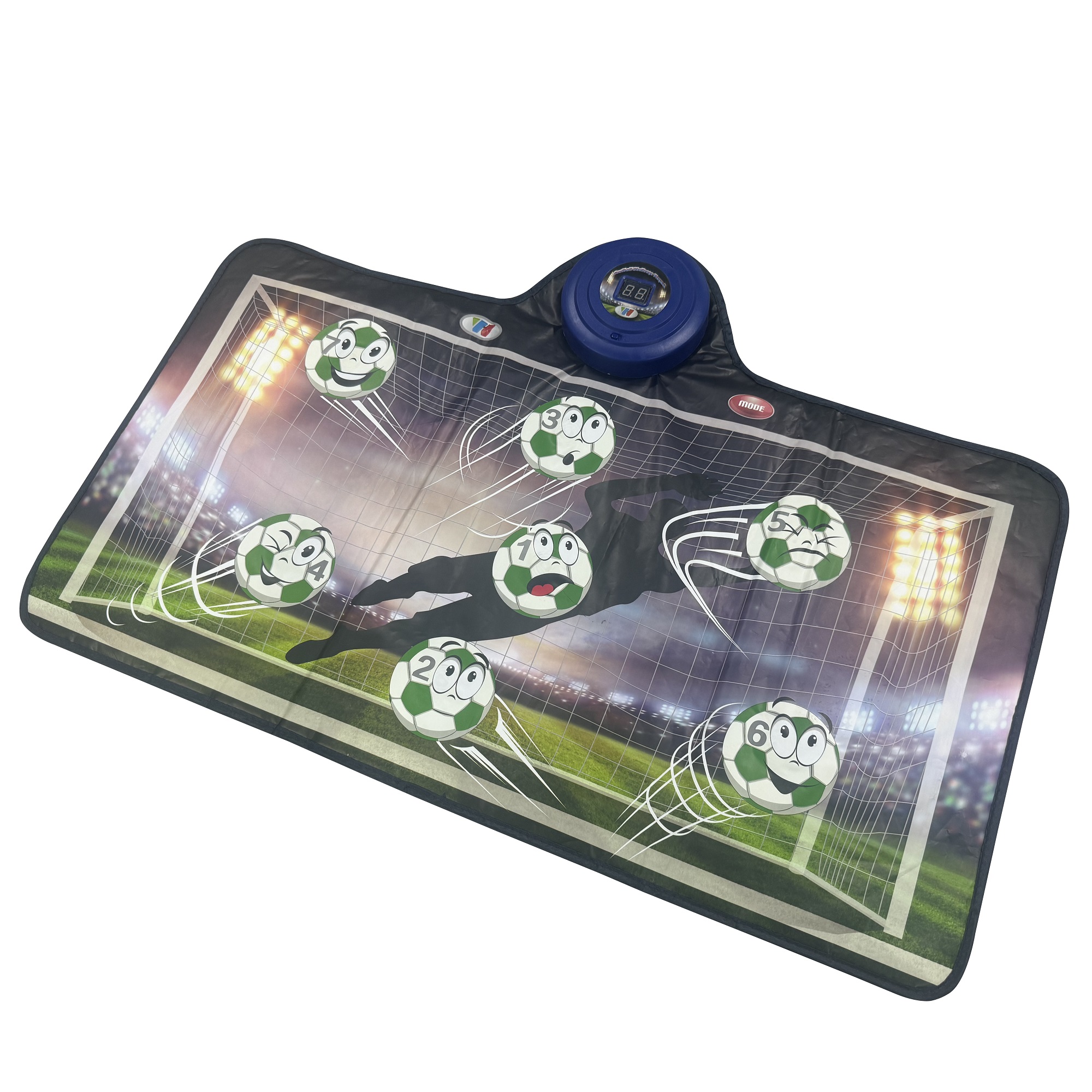
Parents frequently face the difficult "indoor energy" problem. Restrictive weather forces children inside for consecutive days. They still need to burn off their natural physical energy. Running aimlessly through the living room often causes household accidents. A dedicated football challenge mat offers a clearly defined, controlled boundary. It channels their frantic stamina into a much safer area.
Gamification holds a child's attention much longer than traditional practice methods. Static indoor targets quickly become boring. A computerized mat introduces digital scores, countdown timers, and progressive levels. Children treat the mat like a live-action video game. They willingly perform repetitive physical drills. They constantly want to beat their previous high score.
We must maintain transparent and realistic skill development expectations. These electronic devices undoubtedly improve physical coordination, foot agility, and mental reaction time. They help kids connect visual cues directly to physical movements. However, they are not professional athletic training tools. They will never replace formal coaching or actual turf practice. They serve strictly as supplementary, active play.
Play Characteristic | Traditional Indoor Practice | Gamified Playmat Experience |
|---|---|---|
Attention Span | Usually short (5-10 minutes) | Highly extended (30+ minutes) |
Motivation Type | Internal drive or parental pushing | External rewards (lights, sounds, scores) |
Movement Structure | Often repetitive and static | Dynamic, randomized, and reactive |
Feedback Loop | Delayed (requires external observation) | Instantaneous (auditory and visual cues) |
When shopping for a reliable kids sports playmat, you must evaluate several distinct physical components. These factors determine whether the toy survives a week or lasts for years.
Thick materials are absolutely essential for longevity. Manufacturers typically use PVC or heavy-duty vinyl for the top layer. The mat must withstand repeated jumping and hard stomping. Thin plastics tear easily under normal child play pressure. Sensor lag clearly separates premium products from frustrating ones. High-quality mats register steps instantly. Cheaper alternatives often suffer from slightly delayed reactions. This lag completely ruins the rhythm of fast-paced games.
You cannot compromise on basic safety features. An anti-slip backing prevents dangerous falls during rapid movements. Look strictly for EVA foam or rubberized bottom layers. Hardwood and tile floors pose significant slip risks. A high-quality backing grips smooth surfaces tightly. Carpet performance varies widely among brands. Some mats slide dangerously on plush carpets. Always verify specific floor compatibility before purchasing.
Power sources dictate your long-term convenience. Many modern mats utilize USB-C rechargeable batteries. They save money and drastically reduce environmental waste. Standard AA or AAA battery models remain common in budget tiers. Multi-LED displays consume significant electrical power. Loud audio speakers drain standard batteries quickly. Rechargeable units generally offer better reliability for daily active use.
Indoor noise levels escalate incredibly fast. Adjustable volume controls are non-negotiable features. Some days require quiet, concentrated play. A dedicated mute function ultimately saves parental sanity. You want kids to enjoy the flashing lights independently. You do not always want constant electronic sound effects echoing nearby. Always check the packaging for multiple volume settings.
Feature Category | Minimum Acceptable Standard | Premium Level Standard |
|---|---|---|
Surface Material | Standard PVC plastic | Reinforced heavy-duty vinyl |
Bottom Grip | Textured plastic dots | Full EVA foam or thick rubber |
Power System | Requires 3-4 AA batteries | Built-in USB-C rechargeable lithium battery |
Audio Options | Simple on/off switch | Multi-level volume control with total mute |
A high-quality indoor football toy provides diverse and engaging play options. Single-player drills effectively build individual physical confidence. Kids tackle rapid speed challenges against a digital clock. They must memorize increasingly complex light sequences. Stamina modes test their physical endurance over several continuous minutes. These solitary games keep them actively engaged independently.
Multiplayer capabilities naturally extend the product's lifespan. Siblings often want to play competitive games together. Many clever designs facilitate exciting parent-child competition. Dual-zone mats let two players race simultaneously side-by-side. Alternating turns work exceptionally well for single-zone mats. Shared play fosters healthy competition and necessary teamwork skills.
Progressive difficulty is vital for genuine replayability. A mat must realistically grow alongside your child. Adjustable speed settings are incredibly critical here. Five-year-olds need slow, predictable light patterns. Eight-year-olds demand rapid, entirely unpredictable flashes. This careful scaling ensures the toy remains challenging for multiple years.
Proper setup guarantees better safety and extends product longevity. Space requirements matter heavily for active toys. You need a minimum of two feet of clearance around the entire mat. Remove any nearby furniture and sharp tripping hazards. Push loose decorative rugs aside. Ensure kids have adequate room to step off the mat safely.
Storage methods drastically affect the internal sensor lifespan. You should never fold these electronic mats tightly. Sharp creases permanently damage the delicate internal wiring. Bending snaps the hidden conductive pathways. Instead, you must roll the mat loosely. Store it upright in a tall closet or under a bed. This gentle approach preserves the electronic layers.
Cleaning protocols require careful and deliberate attention. These items are technically electronic textiles. Never submerge them in a bathtub or sink. Avoid heavy chemical cleaning sprays. Leaking liquids will inevitably short-circuit the internal motherboards. Use a slightly damp microfiber cloth instead. Wipe down the vinyl surface gently. Dry it immediately and thoroughly with a clean towel.
These interactive floor toys suit specific household needs perfectly. The ideal user profile includes active children ages three to eight. They possess the required coordination to follow fast light cues. They still deeply enjoy imaginative, gamified physical play environments.
When finalizing your actual purchase choice, rely on clear shortlisting logic. Prioritize anti-slip safety above all other features. Ensure the toy has strict, adjustable volume controls. Pick a modern rechargeable power source to maximize your overall return on investment.
Here are your immediate, action-oriented next steps:
Measure your available flat indoor floor space accurately.
Identify whether you will place it on hard floors or carpets.
Check your child's current shoe size against the printed target zones.
Review the manufacturer's warranty period covering electronic defects.
A: You should only use them in dry, covered outdoor areas like patios. The internal electronics are highly vulnerable to moisture and morning dew. Direct UV sunlight can also warp the vinyl surface and degrade the LED visibility. They are fundamentally designed as indoor toys.
A: We strongly recommend wearing grippy socks or playing in bare feet. Hard-soled shoes or sports cleats will permanently puncture the PVC surface and destroy the pressure sensors. Regular socks might cause slipping on the plastic surface, so rubber-grip socks offer the safest experience.
A: Early elementary children typically get the most value. Kids between four and eight years old hit the sweet spot. Their stride length matches the printed target zones perfectly. Furthermore, their cognitive development aligns with the memory and reaction-time games programmed into the mat.
A: Battery life depends entirely on daily usage and LED intensity. Standard AA batteries might last two weeks with an hour of daily play. Rechargeable USB-C models usually offer six to eight hours of continuous active playtime per charge before needing to be plugged in.