
Please Choose Your Language
Views: 0 Author: Site Editor Publish Time: 2026-06-24 Origin: Site
Many parents and gift-givers face a familiar design dilemma. They desperately want a beautiful, minimalist living space. However, babies and toddlers overwhelmingly prefer bright, highly interactive toys. Aesthetic play spaces look stunning in social media photos. Yet, colorful electronic toys often capture and hold a child's attention much longer. This creates a genuine conflict for buyers searching for the perfect present.
Market confusion makes the shopping process even harder. Buyers frequently use the term "piano mat" interchangeably. They unknowingly apply it to two completely different products. One option is an infant kick-and-play gym. The other is a massive, interactive step-on keyboard. They serve entirely distinct developmental stages and address very different physical needs.
This article provides an objective, stage-based evaluation framework. We want to help you make the right choice. You will learn how to match toys to developmental milestones. We will also examine spatial requirements and hardware durability. By the end, you can confidently pick the right option for your child.
Age is the Deciding Factor: Regular piano playmats are essential for infant tummy time and early sensory feedback (0–12 months), while a piano dance mat supports gross motor skills and active play for toddlers (1–5 years).
Hardware Matters: High-quality mats require at least 0.6mm inner padding for durability and low-latency sensor response; cheap 0.2mm alternatives are prone to sensor failure and tripping hazards.
Educational ROI: Both options offer intrinsic, multisensory rewards (action = sound) that outperform passive tablet apps, making them a legitimate rhythm training toy rather than just noisy entertainment.
Shoppers routinely confuse these two distinct product categories. Let us break down their fundamental differences. Each category targets a highly specific age group and supports different physical capabilities.
This product focuses exclusively on early infancy. Its design typically features a soft, washable fabric base. An overhead arch holds various dangling toys. A stationary plastic keyboard sits right at the baby's feet. Babies lie on their backs and instinctively kick the keys.
Its primary use case revolves around tummy time engagement. Infants learn crucial cause-and-effect concepts through repeated foot strikes. They strike a key and hear a distinct sound. This builds vital neural pathways. The overhead toys encourage visual tracking. It acts as an excellent tool for stationary, contained play.
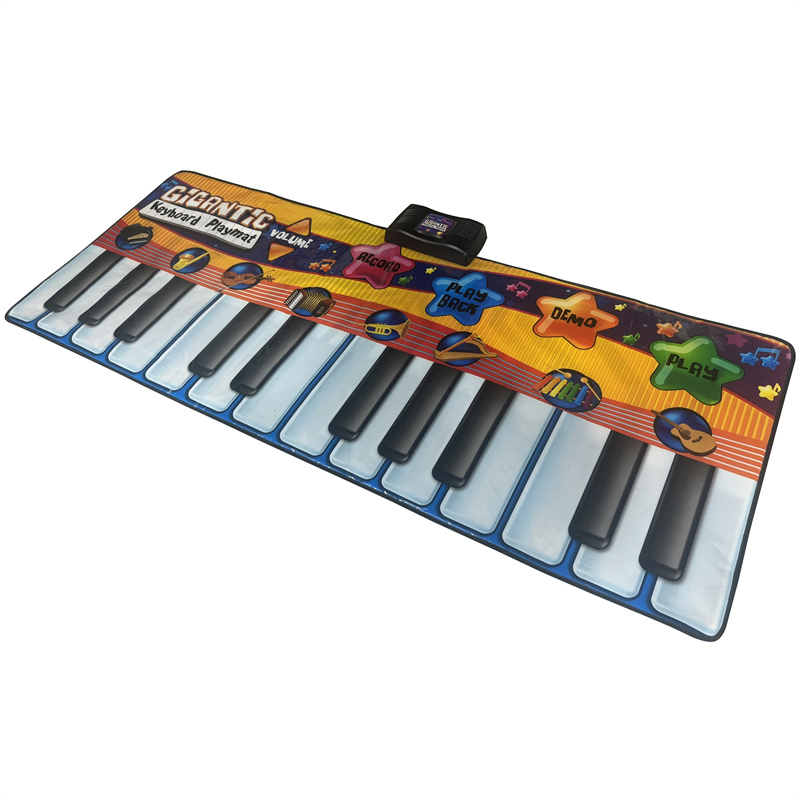
This option caters to highly mobile children. The design features a large piano floor mat. It often spans 71 inches or roughly six feet long. It lays completely flat on the ground. Children must walk, jump, or dance across the oversized keys to create music.
Its primary use case centers on gross motor skill development. Toddlers learn spatial awareness while stepping between different notes. They engage in interactive music creation. Active play effectively replaces passive sitting. You essentially transform a standard living room into a dynamic movement studio.
Feature Category | Regular Piano Playmat | Piano Dance Mat |
|---|---|---|
Target Age | 0 to 12 Months | 1 to 5+ Years |
Physical Posture | Lying down (Back or Tummy) | Standing, Walking, Jumping |
Core Benefit | Visual tracking, early limb control | Gross motor skills, balance, timing |
Hardware Style | Hard plastic keyboard with soft arch | Flat, flexible, touch-sensitive floor mat |
Choosing the correct musical toy requires careful consideration. You should look far beyond the price tag. Evaluate these four criteria before adding an item to your cart.
Developmental Stage & Physical Involvement: You must assess the child's physical abilities. Infants need contained sensory stimulation. They cannot walk yet. Toddlers require full-body kinesthetic engagement. They need a toy mapping directly to their high physical energy.
Sensory Processing Risks: Consider the child's tolerance for noise and bright lights. You want to avoid overstimulation. Flashing lights and loud sounds easily overwhelm some toddlers. Always check for adjustable volume limits. Granular volume control protects delicate hearing.
Spatial Footprint: Compare the required floor space. A kids music dance mat needs continuous open room. You cannot fold it while playing. In contrast, an infant gym offers a highly compact footprint. Many popular infant models fold up easily for quick storage.
Longevity and ROI: Consider how long the child will actually use it. Regular mats peak around 12 to 18 months. After walking begins, infants quickly abandon them. Dance mats scale wonderfully with age. Pre-K music teachers often utilize them for group activities.
Infant playmats consistently dominate baby shower gift lists. They provide immense daily value during the crucial first year of life.
They convert passive floor time into active engagement. This effectively solves the dreaded "tummy time struggle." Babies distracted by music complain much less.
They encourage early limb coordination. Babies receive immediate auditory feedback after a successful kick. This reinforces their desire to move.
They keep pre-mobile infants safely entertained. This temporarily frees up parents' hands for quick household tasks or a brief rest.
They offer very limited physical range. Once the child begins crawling or walking, the stationary design immediately loses its appeal.
Built-in music loops easily become repetitive. Parents often experience a severe "earworm" effect from hearing the exact same songs daily.
You should choose this option for specific scenarios. Buy it for an upcoming baby shower. Select it for any child under one year old. Prioritize models offering removable keyboards. A detached keyboard allows for extended seated play once the baby learns to sit up unassisted.
Toddlers possess seemingly boundless energy. They need durable toys channeling this energy productively. A massive floor keyboard offers the perfect developmental solution.
It acts as an incredibly effective rhythm training toy. Users must maintain balance, carefully time their steps, and practice spatial coordination.
It fosters profound intrinsic motivation. Physical movement directly creates the musical reward. This vastly outperforms external reward systems (like collecting digital stars) utilized by passive tablet apps.
It scales effortlessly for multiplayer or sibling use. Many advanced models feature 24 keys, 8 unique instrument sounds, and built-in record/playback functions.
It requires significant open floor space. You must clear the surrounding area entirely to prevent slipping or dangerous collisions against furniture.
It remains completely inappropriate for young infants. Babies lack the necessary body weight or mobility to trigger the pressure sensors effectively.
Choose this option for highly active toddlers. Preschoolers also benefit greatly from the cooperative play elements. You must look for explicit safety labels. Demand an anti-slip bottom layer. Ensure the top surface remains easy-wipe for inevitable accidents.
Hardware quality strictly dictates the user experience. Poor construction ruins the fun rapidly. You must inspect specific material traits before purchasing.
You should completely avoid ultra-thin options. Many cheap, generic mats measure just 0.2mm thick. We strongly recommend finding 0.6mm internal padding. Thicker padding disperses heavy foot impact safely. It drastically reduces sensor latency. High-quality padding prevents the material from bunching up. Bunched fabric creates severe tripping hazards for clumsy toddlers.
Toddlers are notoriously messy creatures. You must demand completely waterproof surfaces. The material should be easily wipeable. A durable mat survives frequent juice spills. It handles sticky hands without complaint. Quality materials resist color fading over time. They also cleverly prevent bad odors from absorbing deeply into the fabric.
You need to look for non-negotiable electronic requirements. Granular volume control easily tops the list. You absolutely must control the noise output. An automatic shut-off feature proves equally vital. Kids frequently forget to turn their toys off. Auto-shutoff reliably preserves battery life. It also prevents severe parental sensory fatigue.
Hardware Component | Low-Quality Warning Signs (Avoid) | Premium Standards (Seek) |
|---|---|---|
Internal Padding | 0.2mm thickness, feels like thin plastic | 0.6mm thickness, absorbs jumps safely |
Base Material | Smooth, slippery fabric | Textured, anti-slip rubberized bottom |
Sound Control | Single loud volume setting | Adjustable dial, auto shut-off function |
Sensor Response | Noticeable delay after stepping | Instant sound playback upon impact |
The final verdict relies on biology. It does not depend on qualitative preference. You should buy the regular piano playmat for young infants. It actively supports critical early motor milestones. Then, you can upgrade to a piano dance playmat later. Do this once the child confidently walks unassisted. It channels their explosive physical energy into genuine musical exploration.
Next steps involve simple practical checks. First, measure your available living room floor space. Second, rigorously check the manufacturer's age grading. Third, carefully verify the thickness specifications. Always confirm these vital details before finalizing your purchase.
A: They can be if used improperly. You must utilize volume control features. Set the sound to a gentle, comfortable level. You should limit structured play sessions to 10–15 minutes. This prevents unwanted sensory overload. Balancing active electronic play with quiet reading time keeps toddlers well-regulated and happy.
A: They will not teach formal classical piano technique. However, Pre-K educators highly regard them. Teachers use them to teach basic rhythm and cause-and-effect. They also aid in early auditory recognition. Children learn to quickly distinguish different instrument sounds through active, whole-body kinesthetic play.
A: You should spot clean the surface using mild soap and a damp cloth. Never completely submerge the mat in water. Submersion instantly destroys the internal wiring. Store the mat completely flat. If you lack space, roll it loosely. Never sharply fold it, as tight creases damage the sensitive electronic sensors.