
Please Choose Your Language
Views: 0 Author: Site Editor Publish Time: 2026-07-30 Origin: Site
Purchasing a large-scale musical floor piano often stalls at a specific technical specification: determining the optimal number of keys for the intended user. Buyers frequently assume a higher key count equates to a better product. However, increasing the number of keys directly impacts the physical footprint, the distance between sensors (stride length), and the overall durability of the internal wiring. Selecting the right Piano Mat requires balancing musical utility (octaves and polyphony) with physical ergonomics and spatial constraints. This guide provides a framework to evaluate key counts based on user age, intended application, and hardware limitations.
Evaluating the optimal number of keys begins with understanding standard musical structure. A standard musical octave requires eight white keys. To play full chromatic scales, you also need five black keys per octave. When scaling this layout to a floor-based format, manufacturers must decide how many full octaves to include. A single octave severely limits song choices. Two octaves provide enough range to play most standard sheet music melodies. Expanding beyond two octaves increases the physical length of the mat significantly, demanding careful consideration of the user's physical reach and the room's dimensions.
Many consumers fall into the functional black key trap. Manufacturers frequently advertise a high key count to make the product sound more advanced. You might see a product marketed as having 24 keys, but upon closer inspection, the black keys are purely decorative printed graphics. They contain no internal sensors. This discrepancy drastically affects the actual playable range. Always verify whether the advertised key count refers to active sensor zones or just the visual design. If the black keys are inactive, a 24-key mat might only offer 14 functional notes.
Low key counts present distinct melodic limitations. Mats featuring fewer than 10 functional keys restrict users to basic nursery rhymes. You cannot play complex melodies or progress into structured musical education. While these smaller layouts work perfectly for early auditory stimulation, they lack long-term educational value. Children quickly outgrow the limited note selection, rendering the toy obsolete as their cognitive and musical abilities develop.
Conversely, oversized mats introduce the dead zone problem. When a mat stretches across eight or ten feet to accommodate 30 or more keys, the extreme high and low notes rarely see action. Users naturally gravitate toward the center octaves. These unused outer keys represent wasted floor space and unnecessary manufacturing costs. The internal wiring must still travel the full length of the mat, increasing the risk of mechanical failure without providing tangible musical benefits to the average user.
| Key Count | Functional Octaves | Playable Repertoire | Primary Limitation |
|---|---|---|---|
| 10-14 Keys | 1 to 1.5 | Basic nursery rhymes, simple single-note melodies | Lacks range for standard sheet music |
| 17-24 Keys | 2 to 2.5 | Pop melodies, basic duets, standard beginner books | Requires moderate floor space |
| 24+ Keys | 3+ | Complex arrangements, multi-player chords | High risk of sensor failure, massive footprint |
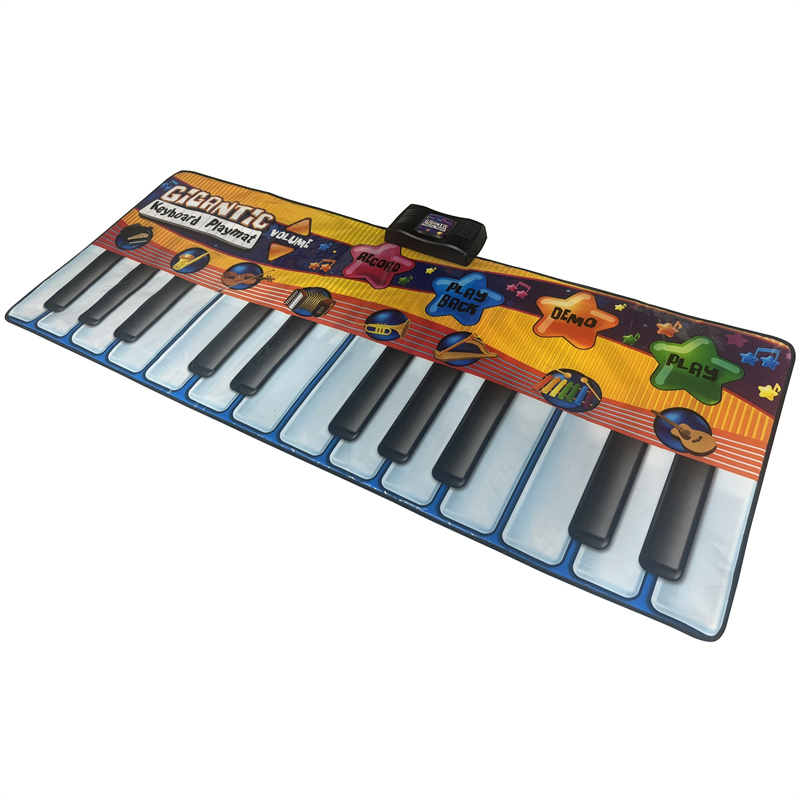
This category serves as the ideal starting point for toddlers and preschool-aged users between one and three years old. At this developmental stage, the primary goal involves gross motor skill development rather than precise musical performance. Children learn cause-and-effect relationships by stepping on a designated area and hearing a corresponding sound.
The ergonomic profile of a 10 to 14-key layout perfectly matches a toddler's physical capabilities. Keys typically measure three to four inches wide. This generous width accommodates poor balance and imprecise foot placement. Early learners can stumble, jump, or crawl across the surface without needing exact coordination. The wider keys ensure they successfully trigger a sound, reinforcing positive feedback and encouraging continued physical activity.
School-aged children, teenagers, and adults find the most value in the 17 to 24-key range. This configuration represents the optimal balance between physical size and musical capability. A large keyboard playmat in this category provides two to two-and-a-half octaves. You cross the minimum threshold required to play standard sheet music, popular melodies, and basic duets.
The form factor usually spans four to six feet in length. This size requires dedicated floor space during use but remains highly manageable for temporary setup and storage. You can easily roll or fold a six-foot mat and store it in a closet. The key width narrows slightly compared to toddler models, requiring more deliberate foot placement. This encourages better coordination and allows users to practice actual footwork techniques similar to dancing.
Mats exceeding 24 keys target specialized environments. Classrooms, therapeutic settings, and households with multiple children benefit from these massive configurations. The extended length allows two or three users to interact simultaneously without colliding. You can facilitate collaborative play, team-building exercises, and complex musical arrangements.
However, this size introduces strict hardware requirements. A jumbo mat must feature advanced polyphony. Polyphony refers to the internal processor's ability to handle multiple simultaneous inputs. If three children jump on the mat at once, the processor must instantly trigger three distinct sounds. Many budget models fail this test, processing only one note at a time. Furthermore, the implementation reality of 24+ key models involves higher failure rates. The complex wiring matrix required to support dozens of sensors across a massive surface area increases the likelihood of circuit breakage during routine folding and storage.
The underlying sensor technology dictates how well a mat performs as the key count increases. Most standard mats utilize carbon membrane sensors. These sensors consist of conductive carbon ink printed onto flexible plastic sheets. When you step on a key, two layers of carbon ink make contact, completing an electrical circuit. This technology works reliably for lower key counts. However, as you scale up to 24 or more keys, manufacturers often must upgrade to copper foil sensors or more complex multi-layered ribbon circuits to maintain signal integrity over longer distances.
Trace routing becomes a significant engineering challenge in larger mats. The conductive traces must travel from the central processing unit to each individual key. Compressing too many keys into a standard layout increases the risk of cross-talk. Cross-talk occurs when stepping on one key accidentally triggers an adjacent note. This happens because the capacitive or conductive traces sit too close together. A heavy footstep compresses the surrounding foam and plastic, inadvertently closing a neighboring circuit. Proper spacing and robust internal shielding become critical as key counts rise.
Microcontroller processing limits also define the user experience. Basic toy microcontrollers struggle to process high key counts efficiently. When a user executes a rapid sequence of steps or attempts to play a chord, a cheap processor cannot keep up. This results in missed notes or noticeable audio lag. The delay between the physical step and the audio output destroys the musical experience. If you plan to play on tempo, you must ensure the internal processor can handle the data load generated by a high number of active sensors.
| Sensor Technology | Durability | Best Application | Cost Impact |
|---|---|---|---|
| Carbon Membrane | Moderate | 10-17 key mats, light residential use | Low |
| Copper Foil | High | 24+ key mats, classroom environments | High |
| Multi-Layer Ribbon | Very High | Professional therapeutic equipment | Premium |
The width of individual keys directly impacts usability. You must evaluate the step distance required to navigate the mat. A piano mat for kids must feature keys narrow enough for a child's natural stride. If the keys are too wide, a child must leap awkwardly from note to note, causing fatigue and frustration. Conversely, if the keys are too narrow, adults or older children will constantly trigger multiple notes with a single footstep.
Assess whether the primary goal involves stationary stepping or active jumping. Stationary play allows for narrower keys, as the user maintains balance and controls their foot placement carefully. Active dancing or jumping requires wider target zones. A wider key provides a larger margin for error when landing. Additionally, active play demands a highly robust, slip-resistant backing to prevent the mat from sliding across hard floors during dynamic movements.
A high key count holds no value if the mat's processor can only handle one input at a time. You must check manufacturer specifications for multi-note capabilities. Polyphony allows users to play chords by stepping on multiple keys simultaneously. This feature is essential for duets or advanced musical practice. Without adequate polyphony, a 24-key mat functions exactly like a 10-key mat, just spread over a larger area.
Latency represents another critical evaluation metric. Larger wiring matrices inherently increase the distance electrical signals must travel. While the speed of electricity is negligible, the processing time required to interpret signals from a complex matrix can introduce audio delay. This latency ruins rhythm games and makes playing along with external music impossible. High-quality mats utilize optimized trace routing and faster microcontrollers to eliminate this delay.
The physical dimensions dictated by the key count must align with your available floor space. Forcing an oversized mat into a small room creates immediate tripping hazards. You need a simple formula for matching mat length to room size: ensure a minimum two-foot clearance around the entire perimeter of the mat. This buffer zone prevents users from colliding with walls or furniture during enthusiastic play.
Storage constraints often dictate the practical lifespan of the product. Higher key counts mean longer mats. Longer mats require more folds to fit into a box or closet. Frequent, sharp folding is the primary cause of internal circuit breakage. Every time you crease the plastic layers, you stress the conductive ink or copper traces. Over time, these micro-fractures sever the connection, resulting in dead keys. If you lack the space to store a large mat loosely rolled, you should opt for a smaller key count.
An inverse relationship exists between the size of a musical floor piano and its lifespan. Longer mats endure significantly more foot traffic. Users constantly walk across the central sections to reach the outer edges. This continuous compression stresses the central wiring hub, where all the individual traces converge before entering the plastic control module. The mechanical stress of heavy footsteps, combined with the inevitable stretching and pulling of a large surface area, accelerates wear and tear. A compact 14-key mat often outlasts a sprawling 30-key model simply because it experiences less structural torque.
Larger mats require more power. More sensors, extended wiring runs, and built-in LED features drain standard AA batteries rapidly. When power levels drop, the audio output suffers immediately. You will notice distorted sounds, fluctuating volume, and unresponsive keys. The microcontroller fails to interpret sensor data correctly when starved of voltage.
Evaluate the trade-off between portable battery power and the need for a dedicated wall adapter. Models with 24 or more keys often benefit from a plug-in power source to maintain consistent performance. However, a power cord introduces a new tripping hazard and limits where you can deploy the mat. Furthermore, on-board miniature speakers struggle to project the complex low and high frequencies produced by a wide octave range. A massive mat might generate deep bass notes and piercing high notes, but a cheap plastic speaker will render them as muddy, indistinguishable noise.
Selecting the right configuration requires matching the hardware to the specific user profile. Use these established match-ups to guide your decision process.
The primary risk to any large mat involves micro-fractures in the conductive ink or wiring. These fractures occur due to improper rolling or sharp folding. When you fold a mat like a bedsheet, you create hard creases that snap the internal circuits.
To mitigate this risk, establish strict storage protocols. Always roll the mat loosely rather than folding it. Treat it like a large rug. Never place heavy furniture, such as chairs or tables, on top of the mat. The concentrated pressure from a chair leg will instantly crush the sensor layers and sever the conductive traces.
Large mats tend to shift on hard floors during active play. Wood, tile, and laminate surfaces provide very little friction against the smooth plastic backing of most budget mats. This shifting creates a severe fall hazard, especially for children running or jumping onto the keys.
Verify the inclusion of a textured EVA foam backing before purchase. If the mat lacks built-in grip, you must require the secondary purchase of non-slip rug pads. Tailor these pads to the exact dimensions of the mat to ensure edge-to-edge stability. Do not rely on small strips of tape; the sheer force of a jumping child will easily tear the tape and cause the mat to slide.
Determine the optimal key count by calculating user stride, room size, and musical intent. Do not default to the largest available option. Measure your intended play area and verify you can maintain a two-foot safety perimeter. Assess the primary user's comfortable jumping stride to ensure the key width matches their physical capabilities. Finally, check the product specifications for polyphony and functional black keys before finalizing your purchase to guarantee the hardware supports your musical goals.
A: For toddlers aged 1 to 3, 10 to 14 keys provide the best experience, focusing on gross motor skills. For children aged 4 and older, 17 to 24 keys offer the necessary range to play actual melodies and practice coordination.
A: It depends on the internal processor. You must check the manufacturer specifications for polyphony. A mat with advanced polyphony can process three or more simultaneous steps, allowing you to play chords successfully.
A: Key widths vary by target age. Toddler mats typically feature keys measuring 3 to 4 inches wide to accommodate imprecise stepping. Mats designed for older children and adults usually have narrower keys, around 2 to 3 inches wide.
A: Yes, adults can use a 24-key mat. This size provides enough octaves for basic musical performance. However, adults must ensure the mat features a durable, heavy-duty PVC surface to withstand the increased weight and impact force.
A: Generally, yes. Mats with higher key counts require longer physical dimensions and more complex internal wiring. This increases the likelihood of mechanical stress, cross-talk, and circuit breakage caused by frequent folding and heavy foot traffic.
A: A standard 17-key mat usually measures around 4 feet in length. You should maintain a minimum 2-foot clearance around the entire perimeter to prevent wall collisions, requiring an open floor space of roughly 8 by 6 feet.
A: Not always. Many budget models feature printed, decorative black keys with no internal sensors. Always verify the product specifications to confirm whether the black keys are active sensor zones or purely visual design elements.