
Please Choose Your Language
Views: 0 Author: Site Editor Publish Time: 2026-06-03 Origin: Site
Modern childhood often unfolds entirely on a screen. Sedentary habits severely limit gross motor development in early life. These habits also delay the acquisition of foundational rhythm. Traditional dance classes offer a structured solution to this problem. However, they can feel incredibly intimidating for beginners. Children who feel "stiff" or uncoordinated often experience frustration rather than joy. They require a private, low-pressure environment to explore movement comfortably. We need an accessible bridge between gamified screen time and active physical training.
Enter the dancing challenge playmat. This interactive tool provides a low-barrier entry into physical activity. It transforms overwhelming dance routines into bite-sized, gamified steps. Kids can practice right in their living rooms. This guide evaluates how these interactive surfaces actively impact motor control. You will discover which features to prioritize for long-term engagement. We also break down the practical realities of setting them up safely. Set aside marketing hype and look at the functional benefits.
Skill Transfer: Dancing mats break down complex physical movements into achievable, step-by-step visual cues, directly improving visual-motor integration.
Progressive Difficulty: The most effective mats utilize distinct modes (e.g., Memory, Challenge, Free Dance) to scale with a child’s improving reaction time.
Purchasing Criteria: Beyond flashing lights, a viable kids dance challenge mat must be evaluated on surface grip, input latency, connectivity (Bluetooth), and storage footprint.
Educational Utility: Quality mats double as cognitive tools, combining physical weight transfer with pattern recognition and number learning.
Let us explore the core loop of a reaction training mat. The process starts in the eyes and ends in the feet. The brain receives a sudden visual cue from an LED light. It must immediately process this signal. Then, it translates the visual information into a targeted lower-body movement. This rapid sequence strengthens critical neural pathways. By practicing this loop daily, children directly improve their visual-motor integration. Fast reaction times become second nature.
Consider the basic biomechanics involved in this activity. Stepping to a beat forces children to shift their center of gravity safely. They must balance on one foot while rapidly moving the other. This dynamic weight transfer builds foundational physical coordination. It directly improves overall balance and joint stability. Proper weight distribution prevents injuries during complex sports later in life. Practicing side-steps also activates underused lateral muscles. This strengthens the entire kinetic chain from the hips down to the ankles.
Many people feel a psychological barrier toward dancing. Kids often freeze up when adults ask them to "perform" in front of others. Gamification removes this pressure entirely. Hitting lit targets feels like a game, not a stressful test. Children naturally lower their inhibitions in this private setting. They repeat movements hundreds of times willingly. This repetition builds essential muscle memory. They overcome physical "stiffness" without the anxiety of a traditional classroom. Gamified feedback loops keep them moving for hours.
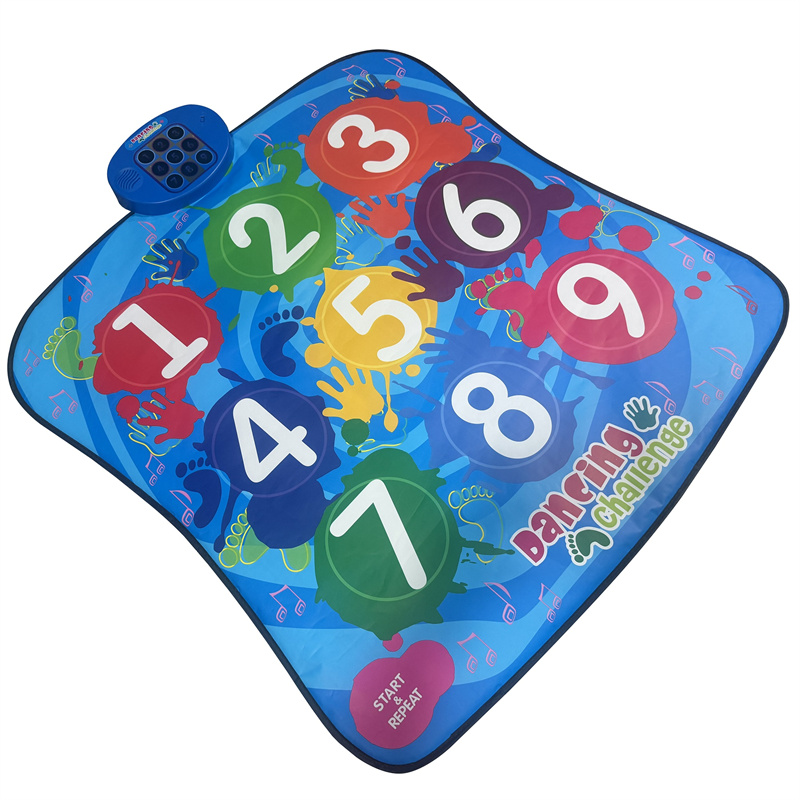
These interactive toys do much more than elevate heart rates. Think about the popular "Memory Modes" included in modern units. The system flashes a sequence of bright lights. The child must remember the exact order and replicate it. As levels progress, these sequences grow longer and faster. This links physical action directly to working memory retention. Combining physical and cognitive loads is a proven framework in neuro-education. Dual-tasking improves focus and enhances overall brain elasticity.
A well-designed number dance mat serves as a powerful early education tool. Teachers and parents pair physical movement with visual identification. Kids step on specific numbers, bright colors, or animal icons to answer prompts. This active learning approach solidifies fundamental knowledge faster than static worksheets. Physical engagement anchors new information in a child's memory. When they associate a sound with a physical jump, they learn faster.
Occupational therapists recognize this immense value. They frequently use interactive floor grids in sensory rooms. Early educators deploy them during indoor recess periods. They help neurodivergent children regulate pent-up energy safely. The structured layout also builds crucial spatial awareness. Kids learn exactly where their bodies are in relation to objects around them. Proprioception improves significantly. They stop bumping into furniture and start moving confidently.
You want an interactive toy that lasts for years. A viable kids dance challenge mat needs genuine mode variety. Manufacturers often rely on flashy gimmicks over substance. Single-key training helps beginners find the beat initially. However, multi-key challenges push advanced users further. If a board only offers one speed, kids quickly outgrow it. Progressive difficulty levels keep the brain guessing. Look for platforms featuring at least five distinct play styles.
Audio source flexibility changes the entire experience. Built-in MIDI tracks get repetitive quickly. Hearing the same five robotic songs causes auditory fatigue. Bluetooth 5.0 integration solves this scalability problem completely. Parents can connect smartphones to stream custom music instantly. You can match the playlist to your child's evolving tastes. This modern feature keeps the hardware relevant for years. Advanced Bluetooth also guarantees stable connections and crisp audio playback without lag.
Size dictates the overall movement quality. A cramped surface restricts natural stepping. It forces kids into awkward postures. Look for dimensions around 40" x 34" for full-body extension. Furthermore, sensor accuracy is absolutely non-negotiable. Low-latency sensors reward precise timing immediately. Delayed feedback frustrates users and ruins the rhythm-training experience. You want instant light flashes and sound effects upon impact.
Feature Category | Standard Models | Premium Models |
|---|---|---|
Music Integration | Pre-loaded MIDI tracks (4-8 songs) | Bluetooth 5.0 for endless custom streaming |
Game Modes | 1-3 Basic modes (Follow the light) | 5+ Modes (Memory, Speed, Animal Sounds) |
Surface Size | Compact (Under 30" width) | Full Size (40" L x 34" W) |
Sensor Feedback | Noticeable input lag | Zero-latency immediate response |
Safety always comes first during physical play. You must place these units on flat, reliable surfaces. Using a lightweight exercise dance mat on polished hardwood poses risks. Without a proper non-slip backing, the material can slide out from under a jumping child. Low-pile carpets often provide the safest friction. Always clear the surrounding floor space before turning the device on. Move sharp furniture edges away from the play zone to prevent accidents.
Power management requires some proactive planning. Most units rely on standard AA batteries. Heavy use of LEDs and Bluetooth speakers drains power fast. Always keep rechargeable NiMH batteries nearby. Portability matters deeply for busy households. Check if the material folds easily along natural creases. This ensures quick storage beneath a bed or inside a closet. Careful folding prevents internal circuit damage over time. Treat the internal wiring gently.
Parents must manage the "novelty wear-off" risk. Kids might play daily for a week, then forget it exists. To maintain engagement, cycle the toy out occasionally. Hide it for a month, then reintroduce it on rainy days. You can also introduce entirely new Bluetooth music tracks to spark interest. Treat it like a dynamic gaming console rather than a static piece of plastic. Organize family tournaments to keep the competitive spirit alive.
Age dictates the ideal feature set. Keep things incredibly simple for toddlers aged three to five. Prioritize durable designs boasting heavy visual feedback. Animal sounds and bright colors hold their attention best. Number identification modes work perfectly for this demographic. They do not need complex rhythm tracking yet. Focus purely on gross motor movement and basic cause-and-effect learning.
Complexity becomes crucial for older kids aged six to nine. They possess faster processing speeds. Look for Bluetooth connectivity and fast-paced memory challenges. Multi-player functionality supports social play among siblings. It also pushes advanced rhythm training. These older users want a genuine challenge. They enjoy breaking high scores and mastering fast tempos. The hardware must withstand aggressive stomping during these competitive sessions.
Before checking out, follow these actionable next steps to ensure a smart purchase:
Assess your child's exact age and current coordination level.
Count the sensor layout (six active buttons provide better variety than four).
Verify the Bluetooth version for seamless smartphone connectivity.
Measure your available floor space to ensure a proper fit.
Confirm the anti-slip material specifications on the base layer.
A well-designed interactive grid transcends viral holiday hype. It operates as a legitimate tool for fostering gross motor skills. It builds genuine confidence in children who typically avoid physical performance. Gamifying movement removes anxiety and encourages repetitive practice. It also boosts cognitive development through pattern sequencing and working memory challenges. You gain a versatile tool for both physical fitness and early education.
Successful adoption requires strategic selection and consistent management. You must choose hardware offering progressive difficulty levels. Practice proper setup in a safe, open space to avoid injuries. Rotate the music library often to keep the experience fresh. By doing so, you provide a lasting foundation for lifelong physical coordination. Turn idle screen time into active, joyful movement.
A: Yes, but performance varies based on the specific material. Low-pile carpets are generally safe. They provide good sensor feedback and prevent slipping. Thick, plush carpets may cause the mat to shift during vigorous jumping. They can also muffle internal sensor inputs. Always test the responsiveness before starting a vigorous session.
A: Absolutely. It breaks down complex rhythm into isolated, gamified side-steps. Kids practice weight transfers repeatedly without feeling self-conscious. This low-pressure environment removes the anxiety of performing. They build foundational coordination and muscle memory step by step. Over time, this repetitive practice translates into natural physical confidence.
A: High-quality models are designed to withstand repetitive stomping and jumping. Manufacturers use reinforced plastics and internal padding. However, longevity depends heavily on the internal wiring quality. You must fold the unit strictly along its natural creases during storage. Improper folding causes severe circuit damage and dead sensors.