
Please Choose Your Language
Views: 0 Author: Site Editor Publish Time: 2026-08-01 Origin: Site
Kinesthetic, sound-based learning offers proven pedagogical benefits for early childhood development. It bridges the gap between physical movement and cognitive retention. However, this active learning style clashes with the physical reality of acoustic management in a shared, multi-station classroom environment. Standard consumer-grade musical mats lack nuanced audio regulation. This creates immediate sound bleed that disrupts concurrent learning centers. It triggers sensory overload in neurodivergent students. Ultimately, this lack of control leads to teachers abandoning the device entirely.
For institutional procurement, an educational musical mat must be evaluated as an acoustically adaptable classroom tool, not merely an interactive plaything. Robust volume control serves as the primary technical differentiator between a disruptive toy and a viable, long-term learning asset. Administrators and educators must prioritize acoustic management to ensure these devices integrate into daily lesson plans without compromising the broader learning environment.
Early childhood learning environments require a specific baseline acoustic profile. Typically, ambient noise in a well-managed classroom averages between 50 and 60 decibels (dB). Maintaining this level allows students to hear instructions clearly without straining. Unregulated sound bleed from a consumer-grade mat heavily degrades the classroom's signal-to-noise ratio. When a mat broadcasts loud, repetitive tones, it forces teachers to raise their voices. This constant vocal escalation induces cognitive and vocal fatigue for educators. It also creates a chaotic auditory environment that hinders student focus.
To understand the impact of unregulated noise, we must look at the physics of classroom sound. Sound waves bounce off hard surfaces like whiteboards, linoleum floors, and glass windows. A toy operating at 85 dB in the corner of a room does not stay in that corner. The sound waves propagate, reflecting and amplifying the overall noise floor. Teachers then have to project their voices over 70 dB just to be heard by students sitting three feet away. This daily strain leads to vocal node damage and severe burnout among early childhood educators.
Modern classrooms operate on a center-based model. Small groups simultaneously engage in reading, math, and motor skills across different stations. This operational reality demands strict acoustic boundaries. Uncalibrated audio shatters these boundaries. When a mat lacks precise volume control, the sound bleeds into the quiet reading corner or the focused math station. Educators are then forced to relegate the music learning playmat to recess, isolated rooms, or storage. This destroys its educational return on investment and deprives students of valuable kinesthetic learning opportunities.
Managing concurrent centers requires strategic placement and equipment selection. Teachers map out their rooms to separate loud activities from quiet ones. However, a mat stuck at maximum volume overrides any spatial planning. Even placing the mat on the opposite side of the room fails if the device lacks a low-volume setting. The inability to turn the sound down means the mat can only be used when the entire class is participating in a loud activity, severely limiting its utility as an independent learning station.
Auditory overstimulation presents a severe barrier to learning for many students. Sudden, high-volume auditory feedback physically and cognitively impacts children with Sensory Processing Disorder (SPD), ADHD, or autism. Unpredictable loud noises trigger fight-or-flight responses. Creating safe acoustic spaces requires predictable, controllable sound environments. Teachers must have the ability to lower the volume to accommodate specific sensory needs. This prevents sensory meltdowns and keeps the classroom inclusive.
Neurodivergent students often require gradual exposure to sensory inputs. A mat that only plays at a high volume removes the teacher's ability to scaffold this exposure. When a student steps on a key and is blasted with a loud trumpet sound, they may develop an immediate aversion to the learning station. Adjustable volume allows educators to set the sound to a whisper, letting the student engage with the tactile and visual elements first, before slowly introducing the auditory component at a comfortable level.
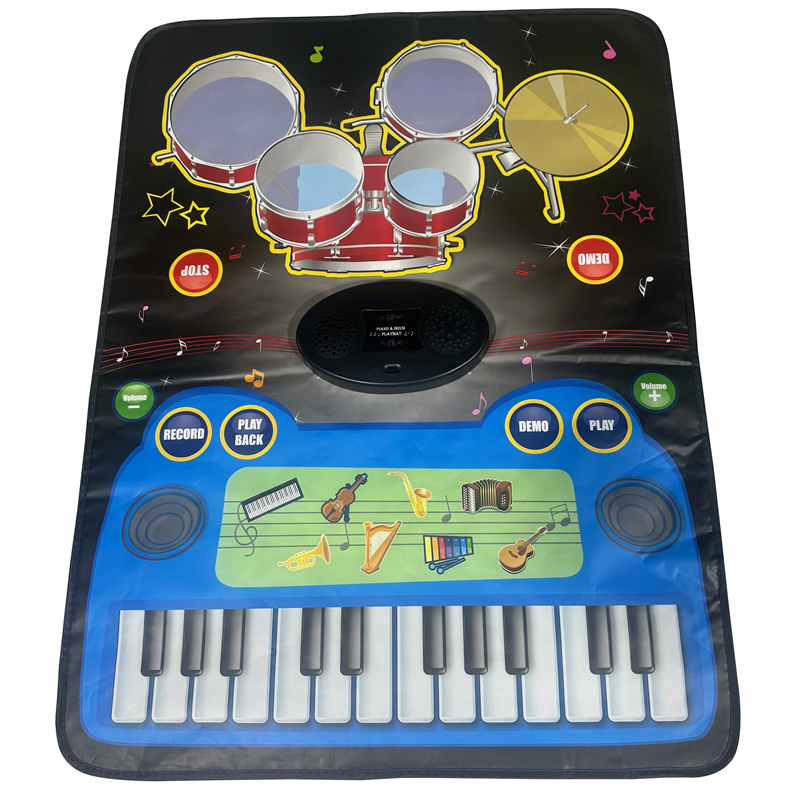
The physical mechanism controlling the volume dictates the mat's longevity and usability. Analog potentiometers, or dials, offer infinite micro-adjustments. However, they present significant mechanical vulnerabilities in a classroom setting. Analog dials accumulate dust, carpet fibers, and liquid disinfectants over time. This leads to static interference or total component failure. In contrast, digital push-button systems provide predictable, repeatable volume steps. Sealed digital switches resist debris and moisture far better than exposed dials, ensuring consistent performance over years of daily use.
When evaluating hardware for institutional use, the failure rate of moving parts must be considered. Analog dials rely on physical contact between a wiper and a resistive track. Every time a child spins the dial with sticky fingers, dirt enters the housing. Over a few months, this dirt scratches the resistive track, causing the volume to jump erratically or cut out entirely. Digital buttons use a simple membrane switch. There is no exposed track to get dirty, making them far superior for high-traffic environments.
| Feature | Analog Dials | Digital Stepped Buttons |
|---|---|---|
| Control Precision | Infinite micro-adjustments | Standardized, repeatable increments |
| Durability | Prone to dust and fiber accumulation | Sealed design resists debris |
| Sanitization | Vulnerable to liquid ingress | Highly resistant to wipe-downs |
| Classroom Lifespan | Short (often fails within months) | Long (withstands daily institutional use) |
Surface-level volume controls invite students to constantly maximize the sound. This design flaw disrupts classroom management. Children naturally gravitate toward louder feedback during active play. Administrative security features solve this issue. Hidden control switches, recessed pinhole adjusters, or firmware-coded button combinations limit volume-adjustment rights strictly to educators. By locking the volume at a predetermined level, teachers maintain control over the acoustic environment without constantly monitoring the station.
Implementing teacher-locked controls changes the dynamic of center time. Instead of a teacher constantly walking over to turn the mat down, they can set the volume before the school day begins. Some advanced models require a specific sequence, like holding two specific keys simultaneously for five seconds, to unlock the volume controls. This prevents accidental or intentional changes by students, ensuring the acoustic zoning plan remains intact throughout the day.
Integrating a 3.5mm headphone jack transforms an early learning playmat into a versatile independent study tool. It facilitates self-guided, isolated learning during quiet reading hours or specialized auditory training. However, pediatric safety remains paramount. Buyers must choose headphone-compatible mats featuring built-in volume caps. Limiting the output to a safe 85 dB prevents noise-induced hearing loss, ensuring that independent play remains both educational and physically safe for developing ears.
Using headphones requires specific logistical planning. Teachers must manage the cables to prevent tripping hazards. Short, coiled cables work best in floor-based applications. Additionally, the headphone jack itself must be reinforced. A standard plastic jack will snap if a student stands up quickly while plugged in. Institutional models feature metal-reinforced jacks and breakaway cables that disconnect safely under tension, protecting both the equipment and the student.
Classrooms require daily sanitizing. This exposes speaker grills and volume buttons to moisture and liquid sprays. Without proper protection, internal circuitry corrodes quickly. Ingress Protection (IP) standards provide a reliable metric for durability. Buyers should look for mats with designated IP ratings, such as IPX4 splash resistance. This rating ensures the internal speaker cones and volume circuitry remain protected during routine cleaning, extending the hardware's operational life.
Sanitization protocols often involve harsh chemicals. When staff spray bleach solutions directly onto a mat, the liquid pools in the speaker grill. If the speaker cone is made of cheap paper, it will warp and dissolve. IP-rated mats use mylar or treated synthetic cones that repel water. The volume buttons are covered by a continuous silicone membrane, preventing any liquid from reaching the sensitive circuit board below.
Low-volume settings enable an educational musical mat to function as a quiet, self-guided station. Students can practice rhythm and gross motor training without constant teacher supervision. This station independence is necessary for managing a busy classroom. Teachers can position the mat closer to other active learning zones when low-volume operation is guaranteed. Spatial flexibility allows educators to optimize their classroom layout without worrying about acoustic interference between groups.
During a typical rotation, one group might be reading with the teacher while another works on math puzzles. A third group can use the mat independently. If the volume is locked at a low setting, the reading group will not be distracted. The students on the mat still receive the auditory feedback they need to complete their rhythm exercises. This parallel processing maximizes instructional time and keeps all students engaged in meaningful tasks.
Acoustic clarity at low volumes separates premium educational tools from cheap toys. High-fidelity dynamic drivers perform exceptionally well at lower decibels. Low-end piezoelectric buzzers lose note definition and distort when the volume drops. Calibrated volume control allows educators to teach dynamic range effectively. Students can learn acoustic dynamics like forte, piano, crescendo, and decrescendo directly on the mat, enhancing their auditory discrimination and foundational musicality.
Teaching musical concepts requires accurate sound reproduction. If a teacher asks a student to identify the difference between a C and an E note, the speaker must produce those frequencies clearly. Cheap piezo speakers compress the sound, making different notes sound identical at low volumes. Dynamic drivers maintain the frequency response curve even when turned down, allowing for accurate pitch recognition and ear training exercises.
Special educators rely on calibrated, adjustable volume steps to execute desensitization protocols. They gradually introduce auditory stimuli to sensory-avoidant students in a controlled manner. Premium mats often compensate for low volume settings by using synchronized LED indicators or haptic vibration pads. This multi-sensory redundancy maintains engagement for hard-of-hearing or highly kinesthetic learners, ensuring the tool supports specific Individualized Education Program (IEP) goals effectively.
For a student with an IEP focused on gross motor coordination, the mat provides a clear target for foot placement. If that student also has auditory sensitivities, the teacher can mute the sound entirely and rely on the LED lights to signal a correct step. As the student becomes more comfortable, the teacher can increase the volume one step at a time over several weeks. This controlled environment builds confidence and helps the student achieve their physical therapy goals without sensory distress.
The sound quality trade-off between speaker types directly impacts classroom usability. Cheap piezo speakers distort and screech when volume levels are adjusted. This creates harsh frequencies that cause listener fatigue. Dynamic coil drivers maintain warm, clean tones across all volume levels. Impact resistance is equally important. Speaker housing placement on the mat must ensure the enclosure can survive being repeatedly stepped on or dropped by young children during vigorous play.
When inspecting a mat for procurement, check the speaker housing. It should be constructed from high-impact ABS plastic and positioned at the top edge of the mat, away from the primary stepping zones. The grill should have small holes to prevent pencils or fingers from poking the speaker cone. Inside, a dynamic coil driver uses a magnet and voice coil to move the air, producing a much richer sound than a flat piezo disc.
Regulatory standards for educational products dictate strict acoustic limits. Floor-based toys must not exceed specific peak decibel levels, typically capped at 80 to 85 dB at a 50cm distance, according to standards like EN 71-1 and ASTM F963. Procurement managers must verify third-party certification reports. Ensuring compliance protects developing ears and shields the district from institutional safety liabilities associated with hearing damage.
Do not rely on manufacturer claims alone. Request the actual testing certificates from recognized laboratories. These documents will detail the exact decibel output at various distances. A mat that peaks at 95 dB is a liability in a classroom setting. Prolonged exposure to levels above 85 dB causes irreversible damage to the tiny hair cells in the inner ear. Institutional buyers must act as the gatekeepers for acoustic safety.
High volume levels accelerate battery consumption in portable mats. Energy efficiency matters for institutional budgets. Frequent AA or AAA battery swaps create hidden operational costs and maintenance headaches. Procurement teams should compare these costs against purchasing mats equipped with rechargeable lithium-ion cells. Automated smart sleep timeout features further reduce power drain, ensuring the mat remains operational throughout the school week with minimal intervention.
A mat running at maximum volume draws significantly more current from the batteries than one running at a low volume. If a classroom uses the mat for two hours a day, standard alkaline batteries might only last a week at high volume. By locking the volume at a lower setting and utilizing a smart sleep function that powers down the mat after three minutes of inactivity, teachers can extend battery life to several months. This reduces the ongoing maintenance burden on the staff.
Students often step on or roll over the volume-up button during active, high-movement play. This causes sudden, disruptive volume spikes. Technical mitigation requires careful hardware selection. Select mats featuring recessed control hubs that sit below the primary play surface. Delayed-press activation, requiring a 3-second hold to change volume, prevents accidental adjustments. Physical slide covers over the control panel also offer a simple, effective barrier against unintended interactions.
Introducing wired headphones into a gross-motor, floor-based play zone creates a high-risk tripping environment. Cables easily tangle around moving limbs. Logistical mitigation is essential. Establish strict seated-use only protocols when headphones are plugged in. Utilize breakaway audio cables that disconnect cleanly under tension. Alternatively, opt for short-coiled headphone cables that stretch only when necessary, keeping the floor clear of loose wires.
When setting up a headphone station, position the mat near a wall. Have the student sit on the mat facing the wall. This prevents other students from walking behind them and tripping over the cable. Route the headphone cable under the student's arm rather than letting it drape across their lap. This keeps the cable close to their body and out of the way of their hands as they interact with the mat.
Spray disinfectants easily seep into speaker grills. This causes corroded wiring or muffled audio output over time. Actionable mitigation requires strict cleaning protocols. Mandate the use of damp sanitizing wipes over direct chemical aerosol sprays. Instruct staff on proper horizontal drying protocols. Never store a damp mat vertically, as moisture will pool at the bottom edge and infiltrate the internal circuitry.
Technology alone cannot solve classroom noise. Teachers must provide a pedagogical framework for acoustic management. Teach students how to adjust the mat's volume based on the acoustic weather of the classroom. If the room is quiet for reading, the mat must be quiet. This approach builds self-regulation and environmental respect. It transforms volume control from a teacher-enforced rule into a student-led responsibility.
Create a visual chart next to the mat station. Use a color-coded system to indicate the acceptable volume level for different times of the day. Red means headphones only. Yellow means low volume for independent work. Green means moderate volume for group play. Teach the students how to read the chart and adjust the mat accordingly before they begin their activity. This empowers them to manage their own learning environment.
An educational musical mat lacking robust, teacher-managed volume control is not a viable learning tool. It becomes an institutional liability that disrupts learning and will quickly be abandoned by frustrated educators. To maximize the value of these devices, administrators must prioritize acoustic adaptability alongside physical durability.
A: Cheap mats use piezoelectric buzzers instead of dynamic coil drivers. Piezo elements struggle to reproduce complex sound waves accurately at lower power levels, resulting in a distorted, screeching tone when the volume is reduced.
A: To comply with safety standards like EN 71-1, floor-based auditory toys should not exceed 80 to 85 decibels at a distance of 50 centimeters. This protects developing ears during close-range play.
A: Direct spraying is not recommended unless the mat has a specific IPX4 or higher rating. Liquid can seep through speaker grills and volume buttons. Always apply disinfectant to a cloth first, then wipe the mat.
A: It is a security feature that prevents students from changing the volume. This can be a recessed pinhole button, a hidden switch, or a specific button combination that only the educator knows.
A: Yes. Pushing more sound requires more electrical power. Operating a mat constantly at maximum volume will significantly reduce battery life compared to running it at a moderate or low setting.
A: Analog dials have exposed mechanical tracks. Dust, dirt, and liquid cleaners enter the housing and scratch the resistive track. This causes the volume to jump erratically or fail completely after a few months of use.