
Please Choose Your Language
Views: 0 Author: Site Editor Publish Time: 2026-06-24 Origin: Site
Parents evaluating floor-time solutions often view playmats merely as cushioned surfaces to protect their infants. You might simply see them as a comfortable spot to lay your newborn down while you fold laundry. However, treating these mats solely as floor decor means missing their critical role as active developmental tools. Without the right sensory and physical feedback, infants may resist tummy time entirely. They could also easily miss crucial early opportunities for cause-and-effect learning, delaying their physical confidence.
We understand how overwhelming it feels to choose the right gear for early development. This article provides a transparent, milestone-aligned evaluation framework. You will discover exactly how to choose a playmat that actively supports gross motor skills. We will also explore how to encourage auditory development safely, ensuring your choice matches your child's rapid growth without causing sensory overload.
A thoughtfully designed baby playmat provides necessary resistance for muscle development and targeted sensory inputs for cognitive growth.
Interactive features like kick-pads teach cause-and-effect, directly encouraging reaching, rolling, and core strengthening.
Auditory feedback must be evaluated for appropriate decibel levels to prevent sensory overstimulation.
Selecting the right mat requires balancing developmental features with material safety, ease of maintenance, and longevity (from newborn to early walking).
Infants require unrestricted movement to hit their developmental milestones on time. Leading public health resources, including early years guidelines from the NHS, consistently link open floor time to improved spatial awareness. When babies move freely on the floor, they learn how their limbs interact within a given space. This unrestricted movement builds the core strength necessary for rolling, sitting, and eventually standing.
Many parents assume maximum padding equals maximum safety. They often purchase the thickest, plushiest mat available. However, overly plush surfaces actually hinder physical development. Think about trying to run on a soft mattress. It absorbs all your energy and makes balance nearly impossible. Babies face the exact same challenge during tummy time. A quality baby playmat balances reliable drop-protection with supportive firmness. This tactile resistance gives infants a solid foundation to push against. Firmness makes lifting their heavy heads much easier. It transforms tummy time from a frustrating struggle into a productive workout.
Visual and sensory anchors play an equally vital role in physical development. Newborns have highly limited vision. They respond best to stark, high-contrast patterns. Black and white geometric shapes immediately capture their attention. When you place these patterns strategically around a mat, they prompt the baby to turn their head. This simple head-turning action naturally strengthens delicate neck and shoulder muscles.
You can evaluate a mat's brain-body support by checking for these essential developmental triggers:
Visual Tracking Targets: Contrasting colors placed at the edges to encourage side-to-side scanning.
Tactile Diversity: Sections of crinkle fabric, smooth vinyl, or ribbed corduroy to stimulate touch receptors.
Firm Resistance: A core material dense enough to prevent the baby from sinking when pressing down with their forearms.
Common Mistake: Relying on soft blankets for floor time. Blankets bunch up, pose a suffocation risk, and offer zero resistance for muscle-building push-ups.
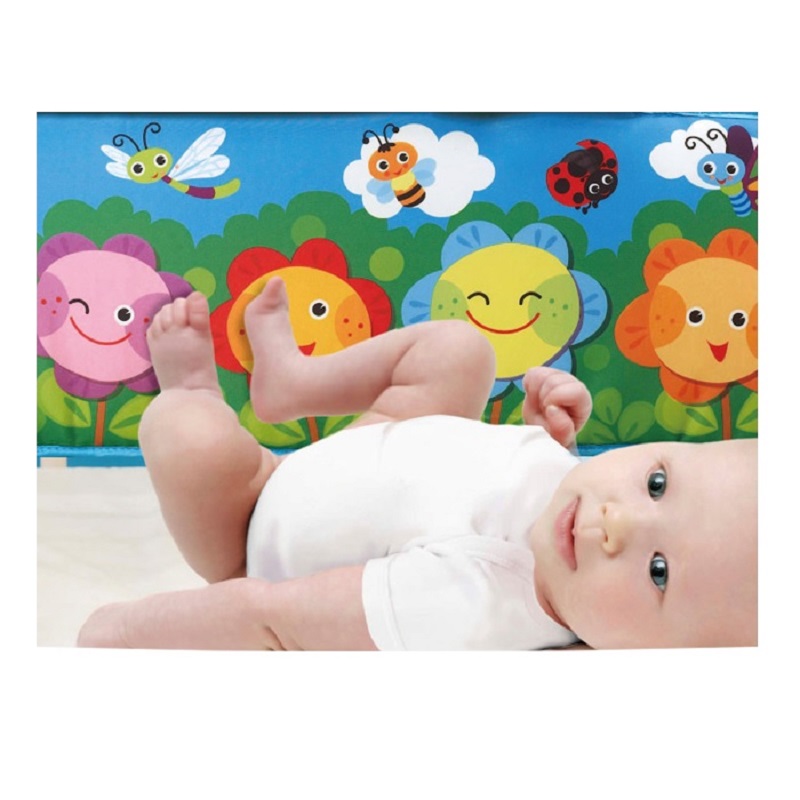
Early physical effort relies entirely on motivation. Infants do not move just for the sake of exercise. They move because they want to interact with their environment. Cause-and-effect learning provides this crucial motivation. When an infant realizes their physical action creates a tangible reaction, they repeat the movement. Responsive features serve as the primary drivers for continuous physical effort.
Mirrors hold a baby's gaze, encouraging prolonged tummy time. Crinkle fabrics reward a weak grasp with an intriguing sound. Kickable pianos reward leg thrusts with instant musical notes. These responsive mechanics turn a passive resting spot into an active learning environment.
Lower body activation prepares an infant for the complex mechanics of crawling. A thoughtfully engineered baby kick n touch playmat encourages purposeful, repeated leg movements. When a baby lies on their back and kicks a tactile pad, they receive immediate physical and auditory feedback. This repeated striking motion actively engages the hip flexors. It strengthens the entire lower abdominal wall. These purposeful kicks build the foundational muscle memory required for eventual forward locomotion.
Upper body reaching is another massive neurological milestone. Babies must learn to stretch their arms beyond their immediate resting posture. Hanging toys suspended from overhead arches naturally encourage this upward reach. Tactile floor elements placed slightly out of grasp encourage forward stretching during tummy time.
Most importantly, these targets encourage crossing the midline. The midline is an imaginary vertical line running down the center of the body. When a baby reaches their right hand across to grab a toy on their left side, they cross this line. This action requires the left and right hemispheres of the brain to communicate. It is a critical precursor to advanced cognitive and motor tasks.
Best Practice: Rotate hanging toys weekly. Changing the visual targets prevents habituation and keeps the infant motivated to reach.
Auditory feedback accelerates cognitive association in growing infants. Sound plays a pivotal role in early brain development. When a baby strikes a specific zone and hears a sound, they map the connection between physical effort and an audio reward. This neurological mapping helps them understand their own agency in the world. They realize they can actively control their environment.
However, we must address the significant risk of sensory overstimulation. Not all sound play benefits an infant. The toy market is flooded with overly aggressive electronic mats. We strongly warn against mats featuring continuous, blaring music or rapid flashing lights. These features cross the line from active learning into passive entertainment. True sound play must be baby-initiated. If an infant taps a mat and triggers a loud, three-minute pop song, they become a passive observer. It overwhelms their developing nervous system.
Signs of overstimulation include averting their gaze, sudden fussiness, crying, or rigid body posture. You must protect your child's sensory threshold by choosing carefully.
When shortlisting a musical city playmat, you must look for very specific control features. Strict volume control is non-negotiable. You need distinct, isolated audio outputs rather than chaotic melodies. A single dog bark or a short piano note provides a clear, understandable reward. Crucially, you must have the ability to turn the electronics off entirely when your baby needs quiet focus.
Use the evaluation table below to differentiate between helpful and harmful sound features:
Feature Category | Beneficial Sound Play | Overstimulating Sound Play |
|---|---|---|
Trigger Mechanism | Baby-initiated (requires a tap or kick). | Continuous play (loops automatically). |
Audio Length | Short bursts (1-3 seconds per action). | Long songs (30+ seconds per action). |
Volume Control | Adjustable settings with a mute switch. | Fixed high volume. |
Sound Type | Distinct notes, single animal sounds. | Complex, chaotic multi-instrumental tracks. |
Babies outgrow their gear at an astonishing rate. Buyers should carefully evaluate the total lifespan of a product before bringing it into their home. Stage-based utility ensures the mat continues to serve a purpose as your baby transitions from a stationary newborn to a highly mobile toddler.
Each developmental window requires a different type of physical support. Understanding these stages helps you select a mat capable of adapting over time.
Months 0-3: Infants need high-contrast visual stimulation and basic tummy time support. The mat serves as a safe, clean space for short intervals of prone positioning.
Months 3-6: Focus shifts heavily to reaching, grabbing, and kicking. Babies begin rolling over. This is the ideal time to introduce baby-initiated audio feedback and tactile overhead toys.
Months 6-12+: Mobility explodes. Babies begin sitting up, pulling to a stand, and cruising. A proper my first steps playmat transitions to offer a safe, non-slip surface. It must provide excellent traction for wobbly feet and adequate impact absorption for inevitable falls.
To accommodate this rapid growth, you must assess modular versus fixed designs. A mat with permanently attached arches becomes a hindrance once a baby starts crawling. Infants need open, unobstructed floor space to practice moving forward. Look for products where you can easily detach overhead arches. Check if the electronic components or side walls can be removed or folded flat.
Modular designs allow the product to scale effectively. You can strip away the sensory arches and leave behind a high-quality, dense foam base. This base continues to protect your child from hard floor impacts long into their toddler years. Fixed designs force you to pack the mat away entirely by the six-month mark.
The final decision comes down to safety, maintenance, and spatial practicality. Interactive features mean nothing if the base materials expose your child to harm or if the mat consumes your entire living room unmanageably.
First, mandate strict material compliance. Babies explore the world using their mouths. They will inevitably chew on the edges of their play space. You must thoroughly check for toxic chemicals. Avoid products containing BPA, phthalates, lead, and PVC. Always look for established third-party certifications. OEKO-TEX certification ensures textiles are free from harmful substances. CPSIA compliance verifies the product meets stringent safety regulations for children's items.
Next, consider the harsh implementation realities. Spit-up, drool, and diaper blowouts are daily occurrences. You must clean this surface constantly. You need to differentiate between machine-washable fabrics and wipe-clean surfaces. Fabric mats often require a full machine wash and air-dry cycle. This takes them out of rotation for an entire day. Conversely, high-density foam or PU leather options wipe clean in seconds using a damp cloth. If you choose fabric, ensure it handles hot wash cycles without shrinking or losing its vibrant colors.
Finally, evaluate size and space integration. You must balance the physical footprint of the mat against your baby's need for an expanding movement range. A compact, circular mat fits perfectly in a small nursery. However, a baby practicing their early crawling mechanics will roll off a small mat in two seconds. If you have hard floors, you might prefer interlocking foam tiles. These allow you to start small and purchase expansion packs as your child's exploratory range grows.
What to watch out for: Beware of deep crevices in interlocking tiles. They can trap dust, pet hair, and spilled milk. Look for tightly fitting joints or seamless foldable designs to minimize trapped dirt.
The right playmat acts as an active participant in your child's early development, far exceeding the role of simple room decor. By prioritizing firm tactile resistance, cause-and-effect interactive features, and safe auditory limits, you directly support crucial motor and cognitive milestones. The best choices grow alongside your baby, transitioning seamlessly from early tummy time to those wobbly first steps.
Take these action steps today:
Audit your primary floor space to determine the maximum footprint you can comfortably allocate.
Determine your current priority based on your baby's age. Decide if you need targeted sensory feedback right now or sheer space for upcoming crawling and walking.
Filter your final options based strictly on non-toxic material certifications and wipe-clean maintenance capabilities.
A: Emphasize frequent, short bursts rather than prolonged sessions. Pediatric guidance suggests starting with just a few minutes of tummy time several times a day. As your baby builds muscle tolerance and neck strength, you can gradually increase the duration. Always follow your baby's cues and stop if they become overtired or frustrated.
A: Yes. Continuous, loud electronic sounds can easily overwhelm an infant's developing nervous system. We recommend limiting electronic sound sessions. Observe your baby's cues carefully. Looking away, arching the back, or sudden fussing are clear signs of overstimulation. Always look for mats featuring adjustable volume and manual, baby-initiated modes.
A: When a baby begins pulling up and cruising, shift your focus away from interactive hanging features. A safe walking mat requires high-density foam for impact absorption. It must feature a strong non-slip backing to prevent sliding on hard floors. Additionally, trip-free, tapered edges are essential to prevent stumbles.
A: Fabric mats with arches are ideal for stationary infants from 0-6 months who are focusing on visual tracking and sensory reaching. However, high-quality, firm foam becomes superior for older infants. Foam provides the stable, tactile resistance required for pushing up, practicing crawling, and eventually standing.